Travelling alone to India for yoga teacher training can feel like two completely different emotions at the same time.
Exciting.
And slightly terrifying.
Maybe you have been dreaming about completing your 200-hour yoga teacher training in Goa, practising yoga near the beach, meeting people from different countries and finally giving yourself a few weeks away from your usual routine.
But then the questions begin.
Is Goa safe for solo female travellers?
Is India safe if I have never travelled there before?
Can I arrive at the airport alone?
Will I feel comfortable walking around by myself?
What happens if I don’t know anyone when I arrive?
If you are asking these questions, you are not being overly cautious. They are sensible questions to ask before travelling thousands of kilometres to a country you may never have visited before.
The short answer is that many women travel independently to Goa every year, including women arriving alone for yoga courses and retreats. But no destination can promise complete safety, and travelling confidently does not mean ignoring basic precautions.
For most first-time visitors, the experience becomes much easier when the accommodation, airport transfer, daily routine and local support are organised before arrival.
This guide explains what solo female travellers should realistically know before coming to Goa for yoga teacher training.
Is Goa Safe for Solo Female Travellers?
Goa has long been one of India’s best-known destinations for international travellers.
People come for beaches, yoga, wellness retreats, nature, food, music and a slower coastal lifestyle.
English is widely used in tourism areas, international travellers are common, and there is a well-developed network of hotels, cafés, yoga centres, restaurants and transport services.
However, being a popular tourist destination does not mean that normal travel precautions disappear.
Goa Tourism itself advises travellers to stay alert, particularly when travelling alone. Its safety guidance recommends avoiding isolated places, deserted beaches late at night and rides from strangers, among other precautions.
So rather than asking:
“Is Goa 100% safe?”
A more useful question is:
“Can I travel to Goa alone confidently if I prepare properly?”
For many travellers, the answer is yes.
And travelling for a structured yoga teacher training program can feel very different from arriving alone with no itinerary, accommodation or local contacts.
Why Yoga Teacher Training Can Be Easier Than Ordinary Solo Travel
One reason first-time solo travellers choose yoga teacher training is that you are technically travelling alone, but you are rarely alone once the course begins.
Your accommodation is organised.
Your classes are scheduled.
Your meals are arranged.
Teachers and staff are nearby.
And within a short period, you normally know the same group of students you will be practising, studying and eating with every day.
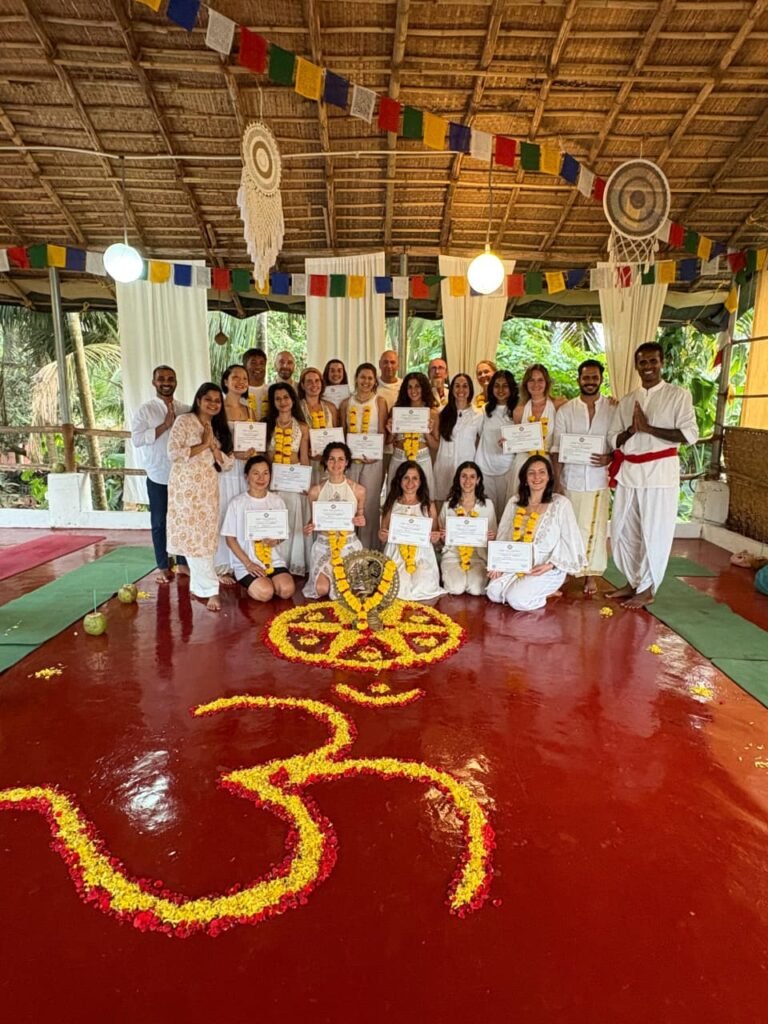
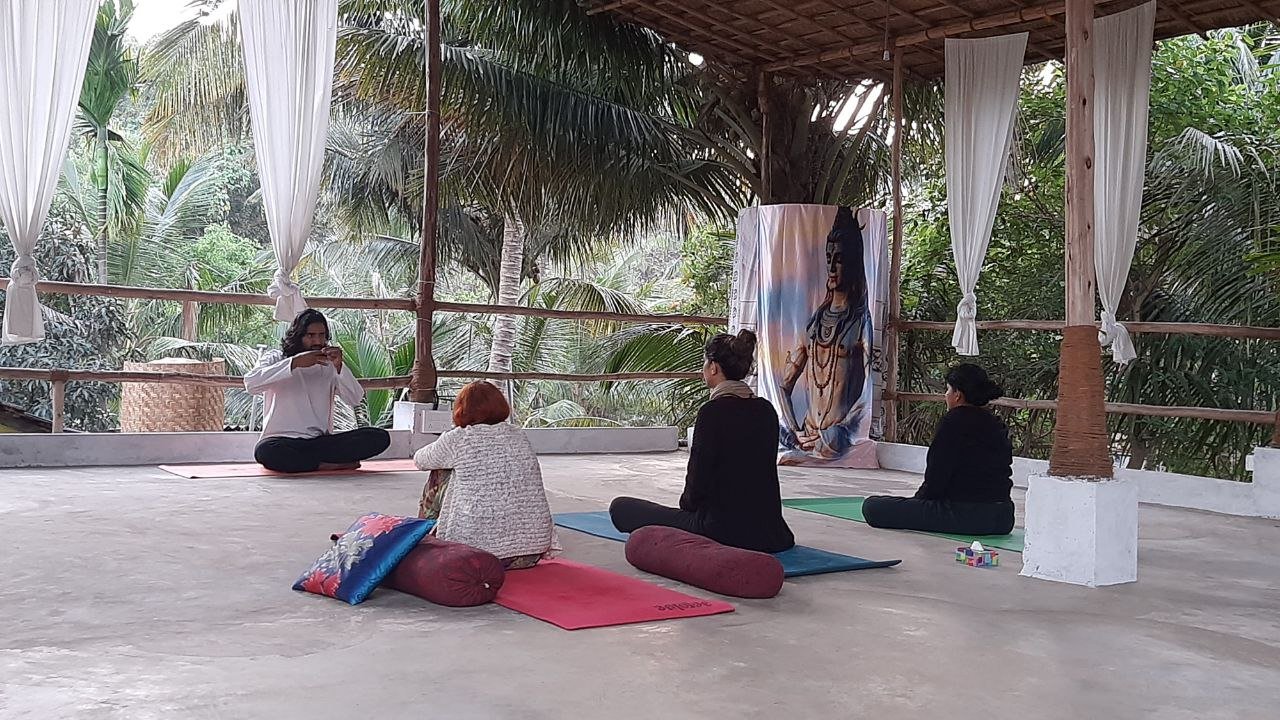
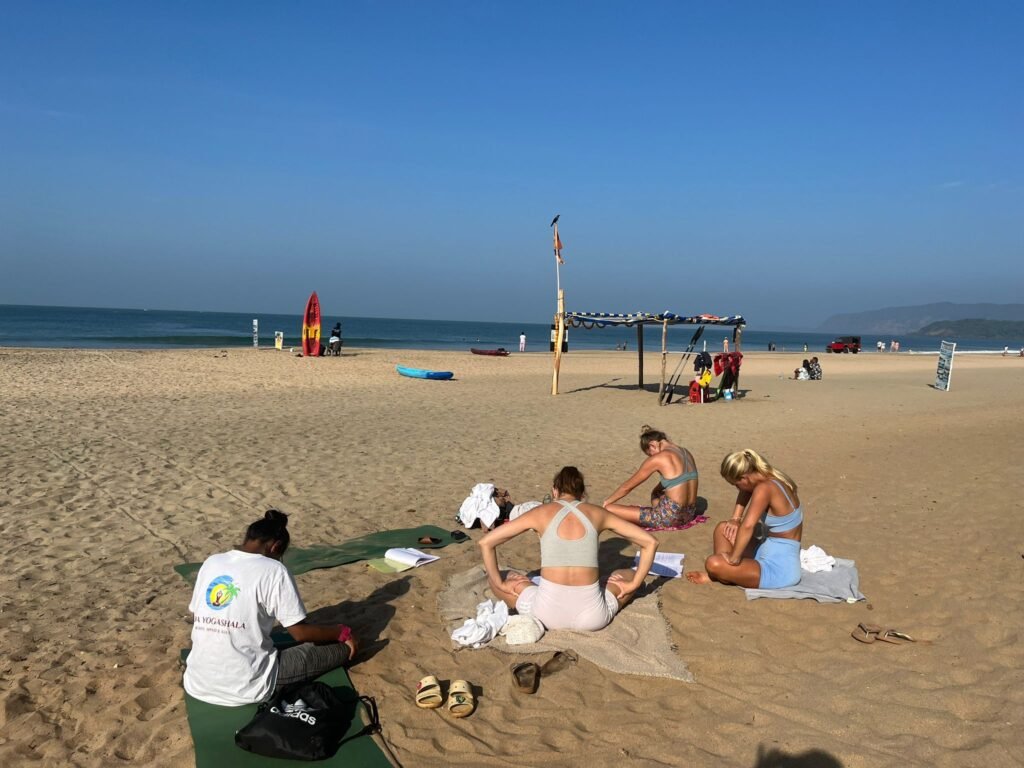
At Goa Yogashala in Agonda, South Goa, students follow a structured daily schedule that includes yoga practice, meditation, philosophy, anatomy, teaching methodology and other sessions.
There are also shared meals and group activities throughout the training.
This creates something that ordinary solo travel doesn’t always provide:
a built-in community.
You may arrive at Goa airport by yourself.
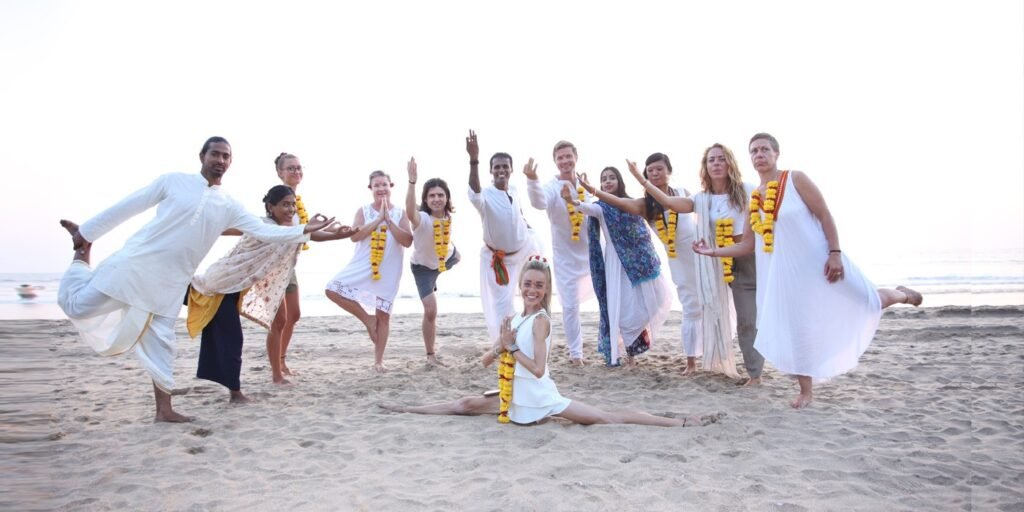
But a few days later, you might be eating breakfast with someone from Spain, practising partner adjustments with someone from Germany and watching a sunset with people you had never met before arriving in India.
For many students, that community becomes one of the most memorable parts of teacher training.

What Is Agonda Like for a Solo Traveller?
Goa is much more diverse than people often imagine.
There are busy nightlife areas.
There are cities and towns.
There are crowded tourist beaches.
And then there are quieter coastal villages.
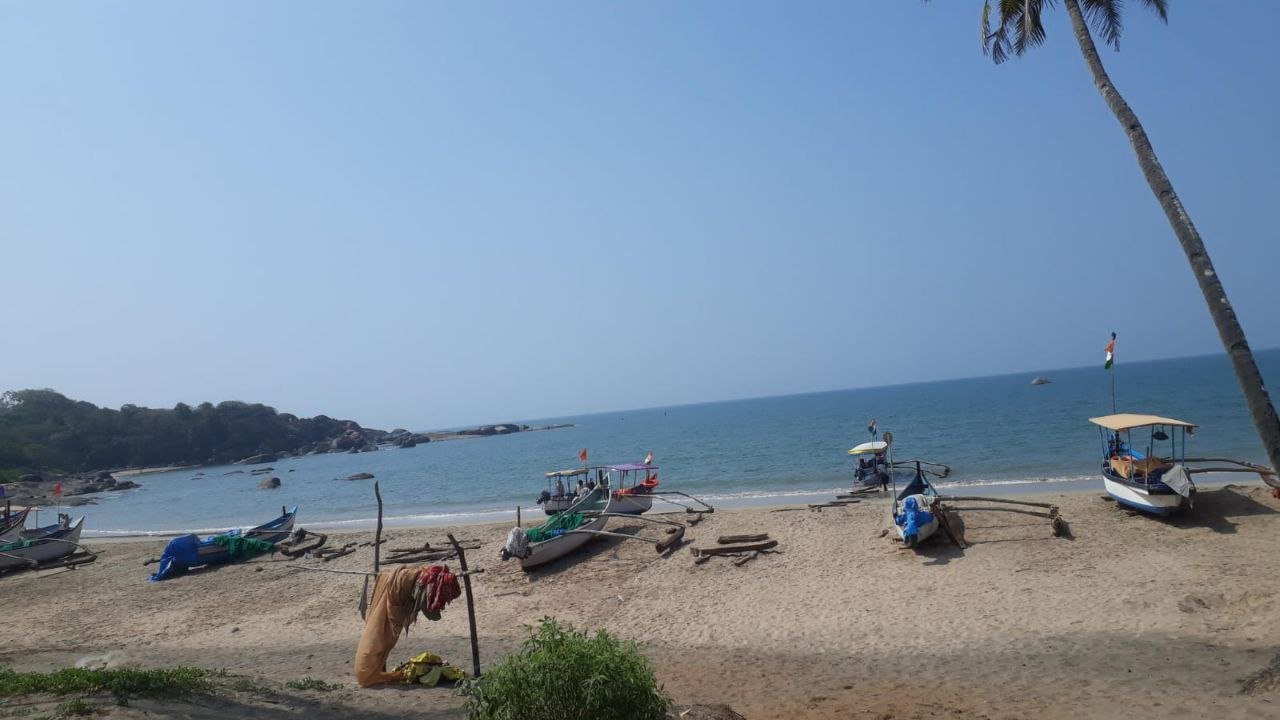
Agonda is located in South Goa, and its atmosphere is very different from the image many people have of Goa as a constant party destination.
Life here tends to revolve around the beach, cafés, yoga, small restaurants, local shops and nature.
For someone coming specifically for yoga teacher training, that slower atmosphere can be helpful.
Your days during YTT are already full.
You may begin early in the morning with meditation or pranayama, continue with asana practice and theory classes, and finish the day with another practice or activity.
You are unlikely to need an intense nightlife scene to keep yourself entertained.
In fact, by the end of some training days, sitting with a cup of tea or walking towards the beach can feel like exactly enough.
“But I’ve Never Been to India Before.”
This is probably one of the biggest concerns we hear from international students.
And it is understandable.
India can feel very different from Europe, the UK, Australia, North America or other parts of the world.
The sounds are different.
Traffic works differently.
Food is different.
The climate may be different.
Social interactions can feel different.
There may be cows beside roads, scooters everywhere, colourful markets, unfamiliar languages and far more activity happening around you than you are accustomed to.
The first 24–48 hours can therefore feel intense for some travellers.
But culture shock does not necessarily mean something is wrong.
Sometimes your brain simply needs time to process a completely new environment.
A useful approach is to avoid planning too much immediately after arrival.
Get to your accommodation.
Shower.
Eat.
Sleep.
Walk around the immediate neighbourhood during daylight.
Meet your teachers and fellow students.
Give yourself permission to settle in gradually.
India does not need to make complete sense on Day One.
Arriving Alone at Goa Airport
For many first-time visitors, arriving at the airport is the moment they worry about most.
The good news is that this part can be planned before you even board your flight.
Goa is served by airports including Goa International Airport at Dabolim and Manohar International Airport at Mopa.
Before booking your flight, check which airport you are arriving at because travel time to South Goa can differ significantly.
If you are joining a yoga teacher training course, ask the school about airport pickup before arriving.
At Goa Yogashala, airport transfer can be arranged separately for students.
This can make your first day dramatically easier.
Instead of landing after a long international journey and trying to negotiate transportation while tired, you already know how you are getting to Agonda.
If you arrange transport independently, use established transport options rather than accepting unsolicited rides.
Goa Tourism lists transport options including GoaMiles, an app-based taxi service operating within Goa.
10 Practical Safety Tips for Women Travelling Alone to Goa
Safety does not need to become the main focus of your trip.
A few sensible habits can remove many unnecessary risks.
1. Arrange your first night’s accommodation before arriving
Your first arrival in India is not the ideal time to improvise accommodation.
Know exactly:
- where you are staying,
- the full address,
- the contact number,
- how you are travelling from the airport,
- and approximately how long the journey should take.
Save these details offline as well.
Do not rely entirely on mobile internet working immediately after landing.
2. Arrange airport transportation in advance
Especially after an international flight.
If your yoga school offers airport pickup, arranging it can simplify your arrival considerably.
Otherwise, use recognised taxis or established app-based services.
Avoid accepting random transportation offers simply because someone approaches you first.
3. Share your travel details with someone you trust
Before leaving home, send a family member or friend:
- your flight number,
- arrival airport,
- accommodation address,
- yoga school contact details,
- travel insurance information,
- and a copy of your passport.
You can also share your live location during long taxi journeys when possible.
This is a useful habit whether you are travelling in India, Europe, Southeast Asia or anywhere else.
4. Avoid isolated beaches late at night
Walking barefoot beside the ocean at night sounds romantic.
But deserted beaches and isolated roads are not good places to be alone late at night.
Official Goa Tourism guidance specifically advises against walking on beaches late at night and recommends that solo women remain vigilant and avoid travelling alone late at night on deserted village roads.
If your group is going somewhere in the evening, go together and arrange transportation back.
5. Be mindful with alcohol
Goa has plenty of bars and nightlife, but your normal safety habits still apply.
Do not leave drinks unattended.
Know how you are returning home before drinking.
Avoid getting heavily intoxicated around people you have only just met.
And never drink and drive.
This becomes even more relevant if you hire a scooter.
6. Don’t give strangers unnecessary personal information
People may naturally ask:
“Where are you staying?”
“Are you travelling alone?”
“How long are you here?”
Most conversations are harmless.
But you don’t need to tell everyone that you are travelling alone or exactly where your room is located.
You can simply say:
“I’m here with my yoga group.”
Which, once your YTT begins, is usually true anyway.
7. Save emergency numbers
India’s integrated emergency number is:
112
Goa Police also lists:
Women Helpline: 1091
Save important numbers in your phone before travelling rather than searching for them during an emergency.
Also save your yoga school contact, accommodation contact and insurance assistance number.
8. Get travel insurance
This has less to do with Goa specifically and more to do with international travel in general.
Travel insurance may help if you experience situations such as:
- medical emergencies,
- flight disruptions,
- baggage problems,
- accidents,
- or other unexpected situations.
Read the policy carefully and confirm that the activities you intend to do are covered.
9. Be cautious with scooters
Scooters are extremely common in Goa.
They can also look easier to ride than they actually are.
If you are not an experienced rider, a foreign country with unfamiliar traffic is probably not the ideal place to learn.
Always follow local laws, wear a helmet and ensure that you have the required documentation and insurance.
For yoga teacher training students staying in Agonda, you may also find that you don’t need a scooter every day.
10. Trust discomfort early
You don’t need a dramatic reason to leave a situation.
If a person, taxi, location or conversation makes you uncomfortable, move away.
Go into a café.
Call someone.
Return to your accommodation.
Join your group.
Ask staff for help.
Your safety is more important than appearing polite.
What Should Women Wear in Goa?
This question comes up frequently among women travelling to India for the first time.
Goa is generally more relaxed about clothing than many travellers expect, particularly in beach areas.
Swimwear is normal at many beaches.
Yoga clothes are common around yoga centres.
Shorts, dresses and casual beach clothing are frequently worn in tourist areas.
However, context matters.
What you wear on the beach may not be appropriate when visiting a temple, church, local village or more traditional environment.
A lightweight scarf or sarong can be surprisingly useful.
You can keep it in your bag and use it whenever you want additional coverage.
For YTT, comfortable yoga clothing is obviously essential.
But also bring loose cotton clothes for the hours between classes.
After several hours of yoga, you may appreciate wearing something other than leggings.
What About Walking Around Agonda Alone?
During daylight hours, students often want to explore local cafés, shops and the beach.
As with anywhere unfamiliar, start by learning your surroundings.
For the first couple of days:
Walk around during daylight.
Notice familiar landmarks.
Ask school staff which routes students commonly use.
Save your accommodation location on your phone.
And avoid wandering into isolated areas simply because Google Maps suggests a shortcut.
Once you know the area, navigating becomes much easier.
At night, particularly if roads are quiet, travelling with another student or group is a sensible choice.
Will I Feel Lonely During Yoga Teacher Training?
This is another concern that isn’t technically about safety but often sits underneath the question:
“Can I really do this alone?”
You might feel nervous when you board the plane.
You may feel emotional when you say goodbye to your family.
And you might wonder what you were thinking when you are sitting alone at an airport halfway across the world.
But yoga teacher training has an unusual way of accelerating friendships.
Think about it.
You spend weeks with the same people.
You wake up early together.
You practise challenging asanas together.
You discuss yoga philosophy.
You learn to teach.
You make mistakes.
You eat meals together.
You experience tired days together.
You laugh about things that only your group understands.
And somewhere between the first nervous introduction and the final week, strangers can begin feeling like family.
You are travelling solo.
But that does not mean your journey will be lonely.
What If English Is Not My First Language?
Don’t let this automatically stop you from considering teacher training.
Yoga courses in Goa attract students from many countries, so it is normal for a group to include different native languages and accents.
You do not need perfect English to make friends.
And you certainly don’t need perfect English to practise yoga.
If you are concerned about understanding course material, ask the school beforehand what language the training is conducted in and whether supporting materials are available in your language.
Goa Yogashala also welcomes students from a wide range of international backgrounds, which means being the only person adapting to another language or culture is unlikely to be a unique experience.
Is It Safe to Eat Food in Goa?
Food is often another major concern for first-time India travellers.
The answer isn’t to become afraid of Indian food.
It is simply to make sensible choices while your body adjusts.
During residential yoga teacher training, having regular meals at the school makes this easier.
At Goa Yogashala, students receive vegetarian meals during the course, reducing the need to search for restaurants for every meal.
When eating elsewhere, choose busy, reputable restaurants or cafés where food appears freshly prepared.
Drink safe drinking water.
Wash or sanitise your hands before eating.
And during your first few days, consider giving your stomach time to adapt before experimenting with every spicy dish you see.
You have several weeks.
There is plenty of time for culinary adventures.
Should I Bring Medication From Home?
Bring any prescription medication you regularly use in sufficient quantity for your trip, along with appropriate documentation when required.
It is also useful to pack a small personal travel kit containing items you already know work for you.
Depending on your needs, this might include:
- basic pain relief,
- electrolyte sachets,
- plasters,
- mosquito repellent,
- sunscreen,
- personal hygiene products,
- and any regular medication.
You can buy many everyday items locally in Goa, so there is no need to bring your entire bathroom cabinet.
Money, Cards and Cash in Goa
India uses the Indian Rupee (INR).
Cards and digital payments are widely used in many places, but carrying some cash remains useful, particularly for smaller local businesses.
A sensible approach is to avoid carrying large amounts of money at one time.
Keep:
- one payment card accessible,
- another stored separately,
- some cash,
- and emergency funds available elsewhere.
Before travelling, inform your bank if required and check international transaction fees.
It is also helpful to know how to temporarily freeze your card through your banking app.
SIM Cards and Internet
Having mobile internet makes independent travel dramatically easier.
You can use it for:
- maps,
- contacting your school,
- translation,
- taxi bookings,
- sharing your location,
- banking,
- and staying connected with family.
Before travelling, investigate whether your phone supports an international roaming package or travel eSIM.
Depending on current regulations and availability, you may also be able to arrange a local SIM after arrival.
Keep screenshots of important information in case your connection temporarily stops working.
The First 24 Hours: A Simple Plan for Solo Travellers
If this is your first trip to India, keep your arrival day simple.
Before your flight
Save your:
- passport copy,
- visa information,
- insurance details,
- school address,
- airport pickup details,
- emergency contacts.
After landing
Connect to airport Wi-Fi or mobile data.
Message your family that you have arrived.
Contact your driver if needed.
Withdraw or obtain a reasonable amount of local currency if necessary.
Go directly to your accommodation.
After reaching Agonda
Check in.
Drink water.
Eat something.
Rest.
Tell someone you have arrived safely.
Take a short walk around the immediate area if it is daytime.
Then sleep.
You do not need to start exploring India immediately.
Your adventure isn’t going anywhere.
Choosing the Right Yoga School Matters
When you are travelling alone internationally, your yoga school becomes more than a classroom.
For several weeks, it is your base.
So before booking, look beyond beautiful Instagram photographs.
Ask practical questions.
Where exactly is the school located?
Is accommodation arranged?
Are meals included?
Can they arrange airport pickup?
Who should I contact if my flight arrives late?
How many students are normally in a batch?
What does the daily schedule look like?
Are there other international students?
Can dietary requirements be accommodated?
What is included in the course fee?
A professional school should be comfortable answering questions like these.
You should never feel pressured to send money before understanding what you are booking.
Why Many Women Choose Goa for Their First YTT in India
Yoga teacher training exists in many places around the world.
So why travel all the way to Goa?
For many students, it is the combination.
You get India.
You get yoga.
You get the coast.
You get international travellers.
You get warm weather during much of the traditional Goa season.
And you can experience Indian culture without giving up the relative familiarity of an established international travel destination.
South Goa adds another layer.
Instead of being surrounded by constant nightlife and traffic, you can build your month around practice, study, nature and the ocean.
Some mornings begin with meditation.
Some afternoons disappear into philosophy discussions.
Some evenings end near the beach.
And somewhere in the process, yoga stops feeling like a 60-minute class you attend a few times a week.
It starts becoming part of everyday life.
What a Day at Goa Yogashala Can Look Like
During yoga teacher training, your days are structured around learning and practice.
A typical day may include:
- morning pranayama and meditation,
- Hatha, Vinyasa or other asana practice,
- yoga philosophy,
- anatomy and Ayurveda,
- alignment and adjustment,
- teaching methodology,
- practical teaching sessions,
- Yin Yoga, Yoga Nidra or restorative practices,
- and shared vegetarian meals.
There are also opportunities during the training to experience activities beyond the classroom.
The purpose is not simply to collect a certificate.
A good YTT gives you time to practise, question, teach, reflect and experience yoga beyond physical postures.
And because you are living this routine alongside other students, connections happen naturally.
You Don’t Have to Already Be “A Yogi”
Another common fear:
“Everyone else will probably be more advanced than me.”
Probably not.
Teacher training groups can include:
- people who have practised for years,
- people who recently became serious about yoga,
- fitness instructors,
- office workers,
- travellers,
- parents,
- wellness professionals,
- aspiring teachers,
- and students who simply want a deeper personal practice.
You do not have to arrive doing handstands.
And you don’t need to look like the yoga teachers you follow online.
Yoga teacher training is called training for a reason.
You are coming to learn.
And You Don’t Have to Want to Teach
Completing a 200-hour YTT does not mean you must immediately become a professional yoga teacher.
Some students come specifically because they want to teach.
Others come because they want to understand yoga beyond asana classes.
Some want a career change.
Some are taking time between jobs.
Some need space after a difficult period of life.
Some simply feel drawn towards India.
Your reason does not have to match anyone else’s.
Red Flags to Watch for When Booking Any Yoga Course
Whether you choose Goa Yogashala or another school, research before paying.
Be cautious if:
- the location is unclear,
- accommodation details are vague,
- nobody answers practical questions,
- the school cannot clearly explain course dates or inclusions,
- you cannot find meaningful information about teachers,
- payment requests feel unusual,
- everything feels rushed or excessively pressured,
- or promises sound unrealistic.
Look through the website.
Read independent reviews where available.
Look at student experiences.
Ask questions.
Have a conversation with the school before booking.
You are committing your time, money and international travel plans.
You deserve clear information.
Emergency Information to Save Before Travelling
Keep these numbers available while travelling in Goa:
Emergency Response Support System: 112
Goa Police Women Helpline: 1091
Goa Police currently lists both 112 for emergency/Pink Force support and 1091 as its women’s helpline.
Also save:
- your country’s embassy or consular contact,
- travel insurance emergency assistance,
- your accommodation,
- your yoga school’s main contact,
- and a trusted person at home.
Hopefully you will never need them.
The point of saving emergency information is precisely so you don’t have to search for it when you are stressed.
So, Should You Travel Alone to Goa for Yoga Teacher Training?
Only you can decide whether solo international travel feels right for you.
But travelling alone does not require becoming fearless.
You can be nervous and still book the flight.
You can feel uncertain and still prepare carefully.
You can miss home and still have an incredible experience.
You can arrive without knowing anyone and leave with friendships that continue across countries.
The goal is not to convince yourself that absolutely nothing can go wrong.
No responsible travel guide can promise that.
The goal is to prepare well enough that fear does not make every decision for you.
Book your accommodation.
Plan your airport transfer.
Research your location.
Save emergency contacts.
Use normal travel precautions.
Stay connected with people you trust.
And once your course starts, allow yourself to actually experience why you came.
Because eventually the question may stop being:
“Can I really travel to India alone?”
And become:
“Why did I wait so long to do this?”

Yoga Teacher Training in Agonda, South Goa
If you are considering travelling to India for your yoga teacher training, Goa Yogashala is located in Agonda, South Goa.
Our training brings together students from different countries for an immersive experience combining traditional yogic learning, practical teaching experience and everyday life in Goa.
Our programs include structured yoga classes, theory and practical sessions, vegetarian meals and accommodation options, with support available before and during your stay.
If this will be your first trip to India or your first solo journey, you are welcome to ask us the practical questions too—not only the yoga questions.
Ask us about your arrival.
Ask about accommodation.
Ask about meals.
Ask about the area.
Ask about airport transfers.
Ask what you should pack.
Knowing what to expect can make the journey feel much less intimidating.
Your yoga teacher training begins when you arrive in Goa.
But sometimes the transformation begins the moment you decide you are brave enough to book the flight.
Frequently Asked Questions
Is Goa safe for a woman travelling alone?
Many women travel independently in Goa, but no destination is completely risk-free. Solo travellers should use normal precautions, including arranging reliable transportation, avoiding isolated locations late at night and keeping trusted people informed about their plans. Goa Tourism specifically provides safety guidance for solo female travellers.
Is South Goa suitable for solo female travellers?
South Goa attracts both Indian and international travellers, including people visiting for yoga, beaches and wellness experiences. Areas such as Agonda offer a different atmosphere from Goa’s busier nightlife centres. Regardless of location, travellers should continue using normal safety precautions.
Can I come to yoga teacher training alone?
Yes. It is common for yoga teacher training participants to arrive individually rather than with friends or partners. Once training begins, students spend significant time together through classes, meals, activities and teaching practice.
Is Goa a good destination for my first trip to India?
Goa can be an approachable introduction to India for international visitors because it has an established tourism infrastructure and receives travellers from around the world. First-time visitors should still prepare for cultural differences and organise essentials such as accommodation and transport before arrival.
Can Goa Yogashala arrange airport pickup?
Airport transfer can be arranged separately. Students should share their flight and arrival information with the school in advance so transportation details can be confirmed.
What should I pack for yoga teacher training in Goa?
Bring breathable yoga clothes, comfortable casual clothing, personal toiletries and medication, sunscreen, mosquito repellent, suitable footwear, travel documents and any electronics you need. A light layer or scarf is also useful.
Do I need to speak Hindi to travel in Goa?
No. English is commonly used within Goa’s tourism industry, and international visitors generally manage day-to-day travel without speaking Hindi or Konkani.
Can beginners join a yoga teacher training course?
Teacher training is not reserved only for people performing advanced yoga poses. The appropriate experience level depends on the individual course, so students should discuss their current practice and any concerns with the school before enrolling.
Final Thoughts
Travelling solo to another country will always involve some uncertainty.
But preparation changes the experience.
Instead of landing and wondering where to go, you have a driver or transport plan.
Instead of searching for accommodation, you know where you are sleeping.
Instead of eating every meal alone, you become part of a group.
Instead of trying to understand India in a few days, you have several weeks to experience it slowly.
And instead of simply passing through Goa as a tourist, you have the opportunity to live here for a while—with a routine, teachers, classmates and a purpose.
For many students, that is what makes travelling to Goa for yoga teacher training feel less like travelling alone and more like taking the first step towards a new community.